Monday, March 26, 2012
Zombies in Medieval Ireland?
You read that right... zombies. I am uncertain what the fascination is with zombies, but apparently the fascination or fear of them has been around since the early middle ages. The people of medieval Europe may not have called the people they treated with aversion as "zombies", but the behavior of the early medieval period suggests that they feared people would come back from the dead or spread unwanted diseases after death, at least, according an article I found at Discovery News today entitled, "Did Zombies Roam Medieval Ireland?" (16 Sep 2011)


Monday, March 19, 2012
Farming in the Isles
I found another book that may be of future interest entitled English Farming, Past & Present by Rowland E Prothero (1917). If my quick perusal is correct, it appears to start sometime just before the 14th century and goes on to describe how farming has changed and morphed over time.
Monday, March 12, 2012
Ireland & the Normans
I found a review (which I uploaded to my Box.net account) published in 1912 of the books Ireland Under the Normans (4 volumes) by Goddard Henry Orpen. Mr. Orpen's books were published in 1911 and can be found at Internet Archive, a positively awesome source for public domain books. In any case, the review inspired me to read Mr. Orpen's books, but they will have to go into the list of "Books I Need to Read". If anyone has read these books and would care to comment, I would appreciate if they are actually worth reading after all. :D
For a glimpse into how and what he writes, Mr. Orpen also wrote "The Effects of Norman Rule in Ireland, 1169-1333", which I have, you guessed it, uploaded to my Box.net account. Happy reading!
For a glimpse into how and what he writes, Mr. Orpen also wrote "The Effects of Norman Rule in Ireland, 1169-1333", which I have, you guessed it, uploaded to my Box.net account. Happy reading!
Monday, March 05, 2012
Tudor Constitutional Documents, 1485-1603
I found the Tudor Constitutional Documents, 1485-1603 as I was wandering around the net earlier today and I thought I would post a reminder blurb.
I find the actual laws and treatise of the time period to be fascinating. I grant that much law verbage is dry and not worth the paper upon which it is written, but every now and then you find a unique and rather interesting bit at random that makes you question long held assumptions. As I go through this book, I may post pieces that are pertinent to Irish research.
I find the actual laws and treatise of the time period to be fascinating. I grant that much law verbage is dry and not worth the paper upon which it is written, but every now and then you find a unique and rather interesting bit at random that makes you question long held assumptions. As I go through this book, I may post pieces that are pertinent to Irish research.
Monday, February 27, 2012
Ancient Leather Cloak
Another article on clothing from the Ulster Archaeological Society, Vol 9, pg 294-300, dated 1861/1862, 'Ancient Leather Cloak' by Robert MacAdam. It is unfortunate that the majority of period information about the medieval Irish peoples comes from people who did not live in Ireland or likely ever set foot upon Ireland's soil, but beggars can't be choosers and we must work with what we have. This article deals with bog finds and is an interesting read. You may find it in my Box.net account.
Monday, February 20, 2012
Maritime Ireland
Another book to add to my future reading list is The King's Customs, Vol 1 by Atton & Holland published in 1908. It is supposed to be "an account of maritime revenue & contraband traffic in England, Scotland and Ireland, from the earliest times to the year 1800." I have yet to challenge this claim, but for now a reminder is set in this post that I need to do so. A quick perusal indicates that the information in the book may start around the time of Edward I or the late 13th century.
Monday, February 13, 2012
Kilt, Mantle & Tartan
I found an article in the Ulster Journal of Archaeology, Vol 6, pg 316-327, dated 1858 entitled 'The Highland Kilt and the Old Irish Dress' by William Pinkerton. In this article he quotes from individuals, which I will transcribe verbatim for those thirsting for more information on Irish clothing. These may or may not enlighten anyone further...
Leslie, Bishop of Ross, in his work, "De Origine, Moribus, et Rebus Gestis Scotorum," published in 1578, thus describes the Highland costume of the period:--[Next paragraph in Latin, if you prefer the original Latin I uploaded the article to my Box.net account.]
The above quotation may be freely rendered as follows:--
"Their clothing, being chiefly suited for war, was made for use, and not for ornament. All--both the nobles and common people--wore mantles of the same kind (except that those of the nobles were variegated at pleasure), long, ample, and gathered into becoming folds: wrapped in these, without any other covering, they slept comfortably. They had also frieze rugs, such as are use by the Irish, which they not only wore on a journey, but also spread upon their beds. The rest of their garments were a most simple trowser; a woollen jerkin, with sleeves open below, for the facility of casting darts; and a very large linen tunic, gathered into numerous plaits, and having wide hanging sleeves descending to their knees. These the rich coloured with saffron, and others smeared with a certain grease, to preserve them longer amidst the toils and exercises of the camp, which they considered it of the utmost importance to practise continually."
The first garment here mentioned by Leslie is clearly the breacan or belted plaid, hereafter to be described. The second is the Irish mantle. The third the trùis, or breeches and stockings in one piece, worn both by Highland and Irish chieftains; the epithet siplicissima denoting its closely-fitting character, in contra-distinction to the puffed and padded out trunk-hose worn by the English and Lowland Scotch of the period. The last--the tunic--is merely the long shirt, leni-croich of the Irish, under probably a more correct denomination.
The accurate and pains-taking Camden describes the Irish dress in almost the very same words as Leslie did the Highland costume. He says:--[Next paragraph in Latin.]
Which may thus be rendered:--"They wear large linen tunics, with wide sleeves hanging down to their knees, which they generally dye with saffraon; short woollen jerkins; a most simple and closely-fitting trùis; and over these they cast their mantles or shaggy rugs (which Isidore seems to call Heteromallae) finged and elegantly variegated, in which they wrap themselves at night, and sleep soundly on the bare ground."
The word "variegated," in both of the preceding quotations, can apply only to a chequered cloth, worn by all the Celtic tribes, and such as we now term tartan; though the word "tartan" was originally applied to the material of the cloth, and had no reference whatever to its colour.The above descriptions are only a part of the article. I encourage people to read Mr. Pinkerton's article, but be warned that some of the information is a bit far-fetched, but that does not negate the possible usefulness of the rest.
Monday, February 06, 2012
Chaucer & Ireland
I was perusing a few random sites today and I ran across an article that caught my fancy, so I wanted to share it. The article I found references a late 14th century work (approximately 1370s) by Geoffrey Chaucer entitled 'Anelida and Arcite' (original text & modern translation). What caught my interest was the title of the article, namely 'Chaucer's Tale of Ireland'. I have uploaded the file to my Box.net account so that anyone else might read the article as well. It's somewhat lengthy in how the author came to the conclusion that he made, but he does give a lot of information on the actual people of the late 14th century.
Monday, September 26, 2011
Gael Agus Gall
I was recently directed to a group recreating this era and I thought I might share it to help out anyone else researching this somewhat hard to research era. Thank you, Alessandra!
Gael Agus Gall
Gael Agus Gall
Saturday, September 03, 2011
Grooming
I found a site today that touched on the grooming practices of the Irish from the 5th - 10th centuries and I wanted to post it here so I wouldn't lose it.
Hair, Jewelry, etc.
Hair, Jewelry, etc.
Monday, February 19, 2007
Sumptuary Revisited
Interestingly enough, sumptuary, according to Dictionary.com didn't come into usage until the late 1500s to early 1600s. Therefore, if there were sumptuary laws of some type before this timeframe, they weren't called sumptuary. So what would they have been called or was this truely a new concept in the late middle ages? I suppose it's possible that before then they didn't have laws like that, but I find that hard to believe when I've seen other research to prove differently or at least, I have seen others claim otherwise. I recall there was an indication that ppl in Ireland were only allowed to wear a certain number of colors or certain colors, dependent on their station in life. I'll have to see what I can find, but using "sumptuary" will likely not get me there.
Sunday, February 04, 2007
Sumptuary Beginning
With the difficulties I had finding 15th century Germanic sumptuary, I determined that 10th century Irish would be more difficult and thus far I've not been proven wrong. In my search tho, I found the following link. It's more general and explains some of the sumptuary practices, but without references, so it's more for an overview than anything. [http://www.geocities.com/davidbofinger/sumptuary.htm]
I have a book concerning the history of Ireland, so we'll see if there is anything of value in it before I expend too much more time on searching for something that some sites have indicated may not have been there during this timeframe.
I have a book concerning the history of Ireland, so we'll see if there is anything of value in it before I expend too much more time on searching for something that some sites have indicated may not have been there during this timeframe.
Friday, February 02, 2007
Notes and Ideas
I have determined that my next area of research will be in the possible sumptuary laws that governed the Irish during my timeframe of study. Late period German research on sumptuary hasn't been amazingly productive, but who knows, maybe I'll get lucky with Irish. :D Most of the sumptuary I'm finding at least for the Germanic people seem to come from religious documents, therefore, that will be my first stop when determining Irish sumptuary and whether or not they had any laws governing the excess of their people.
Monday, January 29, 2007
Picking up...
I've edited the Cycles two posts back, which basically means, I'm trying to do more research again. Only problem I foresee is my current job, but I'll work through that. Might only be able to update every once in a long while, but that's okay. :D
Wednesday, August 09, 2006
Another Roadblock
Okay, apparently this is the wrong time of year to purchase Dress in Ireland by Dunleavy. I'm going to assume classes are just starting in the very near future that need this book as part of its course reading. I have no idea, but this is the second site to cancel my order on me. I'm getting a bit perturbed by this and there is no way I'm paying over $40 for this book. I'm sorry, it's not quite worth *that* much to me. So here I am, left without the book I was wanting yet again and it's core to the research that I'm trying to do *and* I'm unwilling to pay exorbitant amounts to get it. Guess now I can get the Book of Kells on CD instead, but I was really hoping for the Dunleavy book. *sigh*
[End rant]
I'm going to be patient and see where things stand next month. Who knows what might happen :)
[End rant]
I'm going to be patient and see where things stand next month. Who knows what might happen :)
Irish Mythology - Cycles
For a more detailed description of the following, I suggest visiting the Wikipeida entry on Irish Mythology. (http://en.wikipedia.org/wiki/Irish_mythology#The_sources)
One of the best sites to view the Cycles in detail - (http://www.maryjones.us/ctexts/index_irish.html)
Mythological Cycle - Stories of the former gods and origins of the Irish. Sometimes referred to as the Irish Golden Age.
Lore of Places (Metrical Dindshenchas) 4 vol. - the great onomastic work of early Ireland, giving the naming legends of significant places in a sequence of poems. It includes a lot of important information on Mythological Cycle figures and stories, including the Battle of Tailtiu, in which the Tuatha Dé Danann were defeated by the Milesians.
Lore of Women (Bansenchnas)
Book of Invasions (Lebor Gabála Érenn) - a pseudo-history of Ireland, tracing the ancestry of the Irish back to Noah. It tells of a series of invasions or "takings" of Ireland by a succession of peoples, one of whom was the people known as the Tuatha Dé Danann, who were believed to have inhabited the island before the arrival of the Gaels, or Milesians. They faced opposition from their enemies, the Fomorians, led by Balor of the Evil Eye. Balor was eventually slain by Lug Lámfada (Lug of the Long Arm) at the second battle of Magh Tuireadh. With the arrival of the Gaels, the Tuatha Dé Danann retired underground to become the fairy people of later myth and legend. [http://www.maryjones.us/ctexts/leborgabala.html]
The Dream of Aengus (Aislinge Óenguso)
The Wooing of Etain (Tochmarc Étaine)
The (first) Battle of Magh Tuireadh (Cath Maige Tuiredh Cunga)
The (second) Battle of Magh Tuireadh (Moytura - Cath Maige Tuiredh)
The Tragedy of the Children if Lir (Oidheadh Clainne Lir)
The Roll of the Kings (Do flathiusaib Hérend)
The Book of Britain: Irish Nennius (Lebor Bretnach)
The Jewel of the Tuatha De Danann (Tuath De Danand na set soim)
The Satire of Cairpre upon Bres
The Fate of the Children of Turenn (Oidheadh Chloinne Tuireann)
The Progress of the Sons of Mil from Spain to Ireland (Tochomold mac Mileadh a hEspain i nErind)
How the Dagda Got His Magic Staff
How Oengus Won the Brugh (De Gabáil in t-Sída)
The Destruction of Da Derga's Hostel (Togail Bruidne Da Derga)
The Fate of the Children of Lir (Oidheadh Chloinne Lir)
The Fosterage of the House of Two Milk-pails (Altram Tige Dá Medar)
The Tale of Tuan mac Carill (Scél Túain maic Cairill)
The Settling of the Manor of Tara (Suidigud Tellaich Temra)
The Adventures of Leithin (Eachtra Léithín)
The Hawk of Achill (Moí coire coir goiraith)
The Cauldron of Poesy (Arsaidh sin a eoúin Accla)
The Scholar's Primer (Auraicept na n-Éces)
The Ogham Book (Lebor Ogaim)
The Fitness of Names (Cóir Anmann)
Ulster Cycle - Similar to the Mythological Cycle, but would be more like the Irish Heroic Age in comparison. The Ulster Cylce is set around the beginning of the Christian era and most of the action takes place in the provinces of Ulster and Connacht.
The Cattle-Raid of Cooley: The First Recention (Tain Bo Cuailnge)
The Recovery of the Tale of the Cattle Raid of Cooley (Do Faillsigud Tána Bó Cúailnge)
How Oengus Won the Brugh (De Gabáil in t-Sída)
The Quarrel of the Pigkeepers (De Chopur in dá Muccida)
The Tidings of Conchobar son of Ness (Scéla Conchobuir meic Nessa)
The Birth of Conchobhar (Compert Conchobuir)
Medb's Men, or, the Battle of the Boyne (Ferchuitred Medba (AKA Cath na Bóinne))
The Birth of Athirne
Athirne the Unsociable
The Birth of Cú Chulainn (Compert Con Culainn)
The Boyhood Deeds of Cú Chulainn (Maccgnimrada Con Culaind)
The Wooing of Emer (Tochmarc Emire)
TheTraining of Cú Chulainn
Cú Chulainn's Shield
The Death of Derbforgaill (Aided Derbforgaill)
The Pursuit of Gruaidh Ghriansholus (Toruigheacht Gruaidhe Griansholus)
The Tragic Death of Connla, or, the Death of Aife's only Son (Aided Óenfir Aífe)
The Wasting Sickness of Cú Chulainn, and the Only Jealousy of Emer (Serglige Con Culainn)
The Tale of Mac Datho's Pig (Scéla Mucce Meic Dathó)
The Affliction of the Ulstermen (Ces Ulad)
The Debility of the Ulstermen (Noínden Ulad)
The Cattle-Raid of Fraech (Táin Bó Fráich)
The Cattle-Raid of Regamon (Táin Bó Regamain)
The Cattle-Raid of Dartaid (Táin bó Dartada)
The Driving of Flidais' Cattle (Táin bó Flidais)
The Cattle-Raid of Regamna (Táin bó Regamna)
The Intoxication of the Ulstermen (Mesca Ulad)
The Cause of the Exile of Fergus mac Roig (Fochond loingse Fergusa meic Roig)
Bricriu's Feast (Fled Bricrenn)
The Feast of Bricriu and the Exile of the Sons of Doél Dermait (Fled Bricrenn)
The Exile of the Sons of Usnach (Longes mac n-Uislenn)
The Wooing of Ferb (Tochmarch Ferbe)
The Adventures of Nera, or, the Cattle-Raid of Angen (Echtra Nerai [al. Táin Bó Aingen]
The Tragic Death of Cu Roi mac Dairi (Aided Conrói maic Dáiri)
The Colloquy of the Two Sages (Immacallam in Dá Thúarad)
The Death of Celtchar (Aided Cheltchair maic Uthechair)
The Death of Leogaire Buadach (Aided Lóegairi Búadaig)
The Death of Cuchulain (Aided Conculaind)
The Great Defeat on the Plain of Muirthemne (Brislech mór Maige Murthemni)
The Battle of Airtech (Cath Airtig)
The Death of Cet mac Magach (Aided Cheit maic Mágach)
The Death of Fergus mac Roich (Aided Fergusa maic Róich)
The Death of Ailill and Connal Cernach (Aided Ailella)
The Death of Medb (Aided Meidbe)
The Phantom Chariot of Cú Chulainn (Síaburcharpat Con Culainn)
The Genealogy of Cú Chulainn (De genelogia Con Culaind)
One of the best sites to view the Cycles in detail - (http://www.maryjones.us/ctexts/index_irish.html)
Mythological Cycle - Stories of the former gods and origins of the Irish. Sometimes referred to as the Irish Golden Age.
Lore of Places (Metrical Dindshenchas) 4 vol. - the great onomastic work of early Ireland, giving the naming legends of significant places in a sequence of poems. It includes a lot of important information on Mythological Cycle figures and stories, including the Battle of Tailtiu, in which the Tuatha Dé Danann were defeated by the Milesians.
Lore of Women (Bansenchnas)
Book of Invasions (Lebor Gabála Érenn) - a pseudo-history of Ireland, tracing the ancestry of the Irish back to Noah. It tells of a series of invasions or "takings" of Ireland by a succession of peoples, one of whom was the people known as the Tuatha Dé Danann, who were believed to have inhabited the island before the arrival of the Gaels, or Milesians. They faced opposition from their enemies, the Fomorians, led by Balor of the Evil Eye. Balor was eventually slain by Lug Lámfada (Lug of the Long Arm) at the second battle of Magh Tuireadh. With the arrival of the Gaels, the Tuatha Dé Danann retired underground to become the fairy people of later myth and legend. [http://www.maryjones.us/ctexts/leborgabala.html]
The Dream of Aengus (Aislinge Óenguso)
The Wooing of Etain (Tochmarc Étaine)
The (first) Battle of Magh Tuireadh (Cath Maige Tuiredh Cunga)
The (second) Battle of Magh Tuireadh (Moytura - Cath Maige Tuiredh)
The Tragedy of the Children if Lir (Oidheadh Clainne Lir)
The Roll of the Kings (Do flathiusaib Hérend)
The Book of Britain: Irish Nennius (Lebor Bretnach)
The Jewel of the Tuatha De Danann (Tuath De Danand na set soim)
The Satire of Cairpre upon Bres
The Fate of the Children of Turenn (Oidheadh Chloinne Tuireann)
The Progress of the Sons of Mil from Spain to Ireland (Tochomold mac Mileadh a hEspain i nErind)
How the Dagda Got His Magic Staff
How Oengus Won the Brugh (De Gabáil in t-Sída)
The Destruction of Da Derga's Hostel (Togail Bruidne Da Derga)
The Fate of the Children of Lir (Oidheadh Chloinne Lir)
The Fosterage of the House of Two Milk-pails (Altram Tige Dá Medar)
The Tale of Tuan mac Carill (Scél Túain maic Cairill)
The Settling of the Manor of Tara (Suidigud Tellaich Temra)
The Adventures of Leithin (Eachtra Léithín)
The Hawk of Achill (Moí coire coir goiraith)
The Cauldron of Poesy (Arsaidh sin a eoúin Accla)
The Scholar's Primer (Auraicept na n-Éces)
The Ogham Book (Lebor Ogaim)
The Fitness of Names (Cóir Anmann)
Ulster Cycle - Similar to the Mythological Cycle, but would be more like the Irish Heroic Age in comparison. The Ulster Cylce is set around the beginning of the Christian era and most of the action takes place in the provinces of Ulster and Connacht.
The Cattle-Raid of Cooley: The First Recention (Tain Bo Cuailnge)
The Recovery of the Tale of the Cattle Raid of Cooley (Do Faillsigud Tána Bó Cúailnge)
How Oengus Won the Brugh (De Gabáil in t-Sída)
The Quarrel of the Pigkeepers (De Chopur in dá Muccida)
The Tidings of Conchobar son of Ness (Scéla Conchobuir meic Nessa)
The Birth of Conchobhar (Compert Conchobuir)
Medb's Men, or, the Battle of the Boyne (Ferchuitred Medba (AKA Cath na Bóinne))
The Birth of Athirne
Athirne the Unsociable
The Birth of Cú Chulainn (Compert Con Culainn)
The Boyhood Deeds of Cú Chulainn (Maccgnimrada Con Culaind)
The Wooing of Emer (Tochmarc Emire)
TheTraining of Cú Chulainn
Cú Chulainn's Shield
The Death of Derbforgaill (Aided Derbforgaill)
The Pursuit of Gruaidh Ghriansholus (Toruigheacht Gruaidhe Griansholus)
The Tragic Death of Connla, or, the Death of Aife's only Son (Aided Óenfir Aífe)
The Wasting Sickness of Cú Chulainn, and the Only Jealousy of Emer (Serglige Con Culainn)
The Tale of Mac Datho's Pig (Scéla Mucce Meic Dathó)
The Affliction of the Ulstermen (Ces Ulad)
The Debility of the Ulstermen (Noínden Ulad)
The Cattle-Raid of Fraech (Táin Bó Fráich)
The Cattle-Raid of Regamon (Táin Bó Regamain)
The Cattle-Raid of Dartaid (Táin bó Dartada)
The Driving of Flidais' Cattle (Táin bó Flidais)
The Cattle-Raid of Regamna (Táin bó Regamna)
The Intoxication of the Ulstermen (Mesca Ulad)
The Cause of the Exile of Fergus mac Roig (Fochond loingse Fergusa meic Roig)
Bricriu's Feast (Fled Bricrenn)
The Feast of Bricriu and the Exile of the Sons of Doél Dermait (Fled Bricrenn)
The Exile of the Sons of Usnach (Longes mac n-Uislenn)
The Wooing of Ferb (Tochmarch Ferbe)
The Adventures of Nera, or, the Cattle-Raid of Angen (Echtra Nerai [al. Táin Bó Aingen]
The Tragic Death of Cu Roi mac Dairi (Aided Conrói maic Dáiri)
The Colloquy of the Two Sages (Immacallam in Dá Thúarad)
The Death of Celtchar (Aided Cheltchair maic Uthechair)
The Death of Leogaire Buadach (Aided Lóegairi Búadaig)
The Death of Cuchulain (Aided Conculaind)
The Great Defeat on the Plain of Muirthemne (Brislech mór Maige Murthemni)
The Battle of Airtech (Cath Airtig)
The Death of Cet mac Magach (Aided Cheit maic Mágach)
The Death of Fergus mac Roich (Aided Fergusa maic Róich)
The Death of Ailill and Connal Cernach (Aided Ailella)
The Death of Medb (Aided Meidbe)
The Phantom Chariot of Cú Chulainn (Síaburcharpat Con Culainn)
The Genealogy of Cú Chulainn (De genelogia Con Culaind)
Fenian Cycle - The Fenian Cycle is concerned with the deeds of Irish heroes. The stories of the Fenian Cycle appear to be set around the 3rd century and mainly in the provinces of Leinster and Munster.
Colloquy of the Old Men (Acallam na Senórach) - found in two 15th century manuscripts, the Book of Lismore and Laud 610, as well as a 17th century manuscript from Killiney County Dublin.
The Pursuit of Diarmuid and Grainne (Toraigheacht Dhiarmada agus Ghrainne) - is likely the origin of the Tristan and Iseult (Isolde?) story.
Oisín in Tír na nÓg
Historical Cycle
Brat or Cloak
The brat was worn by both men and women and the pictorial evidence is quite consistent. All  show the brat worn around the shoulders. It was secured with a pennanular brooch [example to the right of a falcon pennanular brooch; below that another example of a brooch, tho as to either of their periodness, I haven't researched yet] on the right shoulder for men and below the chin for women. There are no illustrations showing the brat being worn across the body as in 'Braveheart' or in the style favoured by some Welsh groups. The length of the brat was a symbol of wealth and status although by our period it seemed to have been a standard length roughly equivalent to the wearer's height. There is no clear evidence for a hood attached to the brat although some illustrations show the brat worn covering the head and secured as usual with a brooch. If the brat was at least the same length as the
  wearer's height it would be possible to form a hood and still secure it with a brooch. The brat was usually rectangular in shape, of a single colour with a contrasting border. It could be lined with a contrasting colour which wrapped around to form the border. Another decorative device was the addition of a tablet woven fringe or braid, again of a contrasting colour. There is no evidence that the fringe was an integral part of the brat itself. In Henken's Lagore Report he illustrates a method for tablet weaving a fringed braid. When making a brat it would be best to cut a large piece of cloth into narrower strips of material which are then sown together to simulate the cloth production of the period. Strips could vary between 24" and 36".
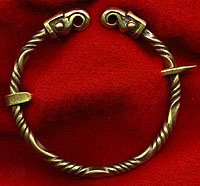 show the brat worn around the shoulders. It was secured with a pennanular brooch [example to the right of a falcon pennanular brooch; below that another example of a brooch, tho as to either of their periodness, I haven't researched yet] on the right shoulder for men and below the chin for women. There are no illustrations showing the brat being worn across the body as in 'Braveheart' or in the style favoured by some Welsh groups. The length of the brat was a symbol of wealth and status although by our period it seemed to have been a standard length roughly equivalent to the wearer's height. There is no clear evidence for a hood attached to the brat although some illustrations show the brat worn covering the head and secured as usual with a brooch. If the brat was at least the same length as the
  wearer's height it would be possible to form a hood and still secure it with a brooch. The brat was usually rectangular in shape, of a single colour with a contrasting border. It could be lined with a contrasting colour which wrapped around to form the border. Another decorative device was the addition of a tablet woven fringe or braid, again of a contrasting colour. There is no evidence that the fringe was an integral part of the brat itself. In Henken's Lagore Report he illustrates a method for tablet weaving a fringed braid. When making a brat it would be best to cut a large piece of cloth into narrower strips of material which are then sown together to simulate the cloth production of the period. Strips could vary between 24" and 36".
Tuesday, August 08, 2006
Leine
This was a garment worn by both men and women and was made of linen. For women it reached to the feet and for men to about ankle length. It was either made from bleached white linen or else a single bright colour which was described as 'gel'. It is possible that the white was reserved for ecclesiastical clothing with the bright colours or plain linen being preferred by everyone else. [Since linen is relatively easy to bleach, I find it much more likely that the linen for most everyone was white. Here's the simple rule (tho I haven't tested this out myself yet): wet linen will bleach white in the sun, dry linen will yellow. I don't recall where I found this information, but I'm going to test this theory on a small swatch of linen from my next purchase.]  that I've gleaned from various places on the net. Not all of these images will help with leine research, but some of them should make it easier to mentally picture what the leine should resemble. This page to the right, for example, while not showing the leine, it is showing a male figure in the top right corner. Tho at first glance it may not appear as if he's wearing anything of significance, on closer examination, it's possible he's wearing a leine pulled up to his thighs as has been represented in various carvings and descriptions of Irish individuals wearing their leine. This method of wearing the leine, which was likely for easier movement and ventilation when necessary, has been misconstrued and misinterpreted as the wearing of a kilt.
The Book of Kells shows leines of various colours e.g. red, green and blue. [I have a theory of which I'm having a difficult time proving, but I believe that the colors represented for or used to describe some of these leine were used for another purpose beyond strickly color. I find in quite a few texts that most of the mantles are green or crimson. Sometimes, tho they are refered to as green, the mantle is in fact another color entirely. Whether this theory ever proves out or not remains to be seen, but for now it's going to sit in the back of my head until I can find proof one way or another.]
The sleeves were wide or loose at the shoulder and tapered to a tight fit at the cuffs. There are no illustrations of wide loose sleeves at the wrist so it is a case of snips, needle and thread for any wide sleeves. The 8th century illustrations show the leine as a loose fitting, single coloured garment decorated at cuffs, neck and hem with bands of braid or embroidery. There is no pictorial evidence for two or multi coloured leini. The neck opening was usually circular with an occasional v shape being used. The plates of the Shrine of St Moedoc could possibly represent pleated leine as the folds seem too regularly defined for a representation of normal folds in cloth. As the shrine is 11th century it could possibly indicate a fashion or style change influenced by the Scandinavian pleated kyrtle. The leine was secured about the waist with a crois or belt. This was made of either tablet woven wool or leather and would also serve for hanging a pouch, knife or other articles. In warm weather or when engaged in work or fighting the leine would be 'pouched ' over the crois to allow greater mobility. The depiction of Cain and Able on the Cross of Muiredach at Monasterboice shows the leine being worn in this manner. Likewise a warrior depicted on the Cross of Scriptures wears his leine gathered. It should not be confused with a kilt for which there is no evidence.
On careful examination of the available evidence and in consultation with others, I have found no credible evidence that the Irish or Scottish Gaels gathered or pleated the sleeves of their shirts along the top of the arm. Leine is pronounced, very roughly, \LANE-yeh\, where \LANE\ is like the English word "lane" and the \y\ is like the one in the English word "yes". (http://www.medievalscotland.org/clothing/leine.shtml)
One point to bear in mind is that drawstrings in the sleeve of a leine is a contemporary development, coming out of American RenFaires in the 1960-70s Be careful what advice you take. (http://garbindex.com/content/leine.php)
Quoting from "Irish Noble Dress: 5th century B.C. to 17th century C.E." by T.H. Lady Lughbec ni Eoin (Nancy Lynch)
--"Styles and fashions of many differing centuries were worn side by side throughout the Middle Ages in Ireland. The Gaeils, being proud to display their connections to the past, traditionally honored their lineage by wearing garments to recall ancestral heros or events. Up to and including the Anglo-Norman period, just about any Irish garment style that was worn in earlier periods would have been worn by some Irish noble person. After the 12th century there were many confrontations regarding this custom and all other "things Irish" between the Anglo/Normans who had invaded the island country, and the Gaeil. Then in the 14th century the English=Tudors began strengthening the anti-Irish policies, becoming firmer with each succeeding monarch. Legislation, punishments, and even death sentences were doled out to those of the aristocracy and peasantry, both English bred and Gaeil, caught by those in power, wearing clothing or hairstyles "after the Irish fashion". The Tudor-English Crown was bent on Anglisizing and "de-Irishizing" all of Ireland."-- (http://www.geocities.com/Athens/Delphi/4715/costume/clothing.html)
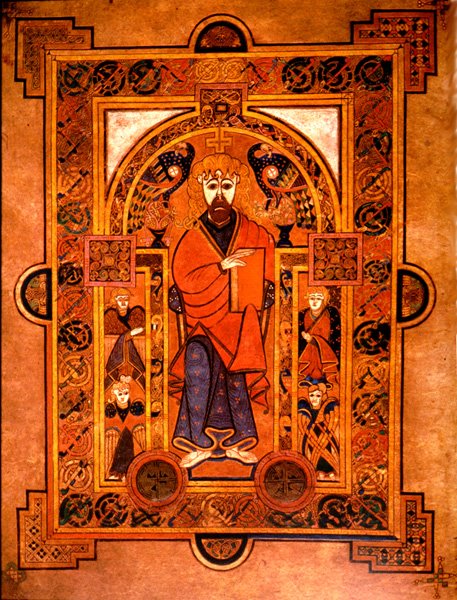

 that I've gleaned from various places on the net. Not all of these images will help with leine research, but some of them should make it easier to mentally picture what the leine should resemble. This page to the right, for example, while not showing the leine, it is showing a male figure in the top right corner. Tho at first glance it may not appear as if he's wearing anything of significance, on closer examination, it's possible he's wearing a leine pulled up to his thighs as has been represented in various carvings and descriptions of Irish individuals wearing their leine. This method of wearing the leine, which was likely for easier movement and ventilation when necessary, has been misconstrued and misinterpreted as the wearing of a kilt.
Gael Agus Gall / Vikings Online
I think I found a good basis for how I'm going to mold my own garb. I found this group, Gael Agus Gall, which is a living history group that concentrates on 10th century life and crafts. More specifically, their focus is Hiberno Viking and Gaelic (tho more Viking due to available resources). Using their site (http://homepage.eircom.net/~gael/gaelweb/kit.html) [this site is also copied or was a copy and can be found at http://www.vikingsonline.org.uk/resources/authenticity/gaelic/index.htm. I'm uncertain which is the originating group I'm afraid] and the references provided, I think there is a strong basis in what a feasible kit would be for my persona. In the next few posts, I'm going to put their descriptions of the various pieces of clothing as well as pictures and addendums that they didn't post with their information. Anything below within []s are my own additions.
To start, these are the principal resources from which they pulled their descriptions...

1. Cross of the Scriptures at Clonmacnoise
[Clonmacnoise has three crosses. The Cross of the Scriptures has quite a few panels of which are listed:
West face (pictured right above) - Watching of the Tomb, the Arrest, the Betrayal and, above, the Crucifixion;
East face (pictured right middle) - King Dermot is depicted helping St Ciaran to lay the cornerpost of the church, above this are a number of unidentified figures, and above these again, the Last Judgement
South face - a Bishop and David with his Harp
North face (pictured right bottom) - another bishop, a man with Pan pipes and a falconer
Base - a hunting scene with horsemen, chariots and various animals. If I can find more detailed pictures of these crosses I'll post them at a later date and time.]
2. Cross of Muiredach at Monasterboice ( 923 AD. )
[Info in a previous post.]
3. Cross of Durrow
4. Cross of Kells
5. Book of Kells ( 8th century )
6. Shrine of St. Moedoc ( 11th century )
7. Giraldus Cambrensis ( 1183 - 1185 ) and other various texts, annals and reports for references to colour and textiles.
8. Durer's drawings in the 16th century of Irish poor men and soldiers.
Some of these I've already explored in minor detail and as things progress I'll explore more thoroughly. (Especially after I purchase the Book of Kells on CD :D) Until then, more happy research in the future.
To start, these are the principal resources from which they pulled their descriptions...

1. Cross of the Scriptures at Clonmacnoise
[Clonmacnoise has three crosses. The Cross of the Scriptures has quite a few panels of which are listed:
West face (pictured right above) - Watching of the Tomb, the Arrest, the Betrayal and, above, the Crucifixion;
East face (pictured right middle) - King Dermot is depicted helping St Ciaran to lay the cornerpost of the church, above this are a number of unidentified figures, and above these again, the Last Judgement
South face - a Bishop and David with his Harp
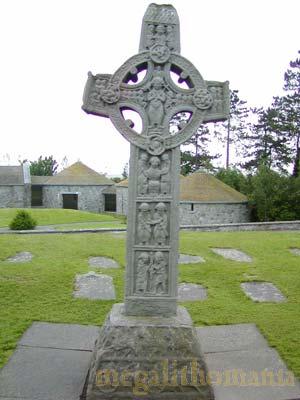
North face (pictured right bottom) - another bishop, a man with Pan pipes and a falconer
Base - a hunting scene with horsemen, chariots and various animals. If I can find more detailed pictures of these crosses I'll post them at a later date and time.]
2. Cross of Muiredach at Monasterboice ( 923 AD. )
[Info in a previous post.]
3. Cross of Durrow
4. Cross of Kells
5. Book of Kells ( 8th century )
6. Shrine of St. Moedoc ( 11th century )

7. Giraldus Cambrensis ( 1183 - 1185 ) and other various texts, annals and reports for references to colour and textiles.
8. Durer's drawings in the 16th century of Irish poor men and soldiers.
Some of these I've already explored in minor detail and as things progress I'll explore more thoroughly. (Especially after I purchase the Book of Kells on CD :D) Until then, more happy research in the future.
The Second Battle of Moytura
The Second Battle of Moytura
ftp://ftp.ucc.ie/pub/celt/texts/T300011.txt
This is a section from the Mythological Cycle found more by accident than design. I'll put together a listing of the various cycles after I'm finished with this current mental thread.
Clothing references are as follows:
"A mantle with bands of golden thread was around him. His shirt had trimmings of golden thread. On his breast was a brooch of gold, with the sheen of a precious stone therein. Two white silvern spears, and in them two smooth riveted shafts of bronze. Five circlets of gold on his neck. A golden-hilted sword with (inlayings) of silver and studs of gold."
"Unseemly was his apparel. A cape to the hollow of his two elbows. A dun tunic around him, as far as the swelling of his rump. It is, moreover, long-breasted, with a hole in the peak. Two brogues on him of horse-hide, with the hair outside. A wheeled [gap: meaning of text unclear/extent: one word] fork to carry which required the effort of eight men, behind him so that its track after him was enough for the boundary-ditch of a province."
ftp://ftp.ucc.ie/pub/celt/texts/T300011.txt
This is a section from the Mythological Cycle found more by accident than design. I'll put together a listing of the various cycles after I'm finished with this current mental thread.
Clothing references are as follows:
"A mantle with bands of golden thread was around him. His shirt had trimmings of golden thread. On his breast was a brooch of gold, with the sheen of a precious stone therein. Two white silvern spears, and in them two smooth riveted shafts of bronze. Five circlets of gold on his neck. A golden-hilted sword with (inlayings) of silver and studs of gold."
"Unseemly was his apparel. A cape to the hollow of his two elbows. A dun tunic around him, as far as the swelling of his rump. It is, moreover, long-breasted, with a hole in the peak. Two brogues on him of horse-hide, with the hair outside. A wheeled [gap: meaning of text unclear/extent: one word] fork to carry which required the effort of eight men, behind him so that its track after him was enough for the boundary-ditch of a province."
Subscribe to:
Posts (Atom)